IETF 127
Hilton San Francisco Union Square, San Francisco, California.
What interests me
The connections that stood out at IETF 127 concern people and their agents moving between public resources, workplace services, and communications. How can services control abuse without closing access? What survives when authority passes through several agents? Which identity and key bindings need a durable history? Those questions connect the sessions below to ongoing implementation work.
Connections worth exploring
MOLE and anonymous bot authentication explore abuse controls without identifying each visitor to a site. Web Bot Auth instead lets an automated client authenticate itself. Resource operators also need to express how content may be used through AI preferences. The interesting tension is managing costs and abuse while leaving room for independent agents and people who do not want another account.
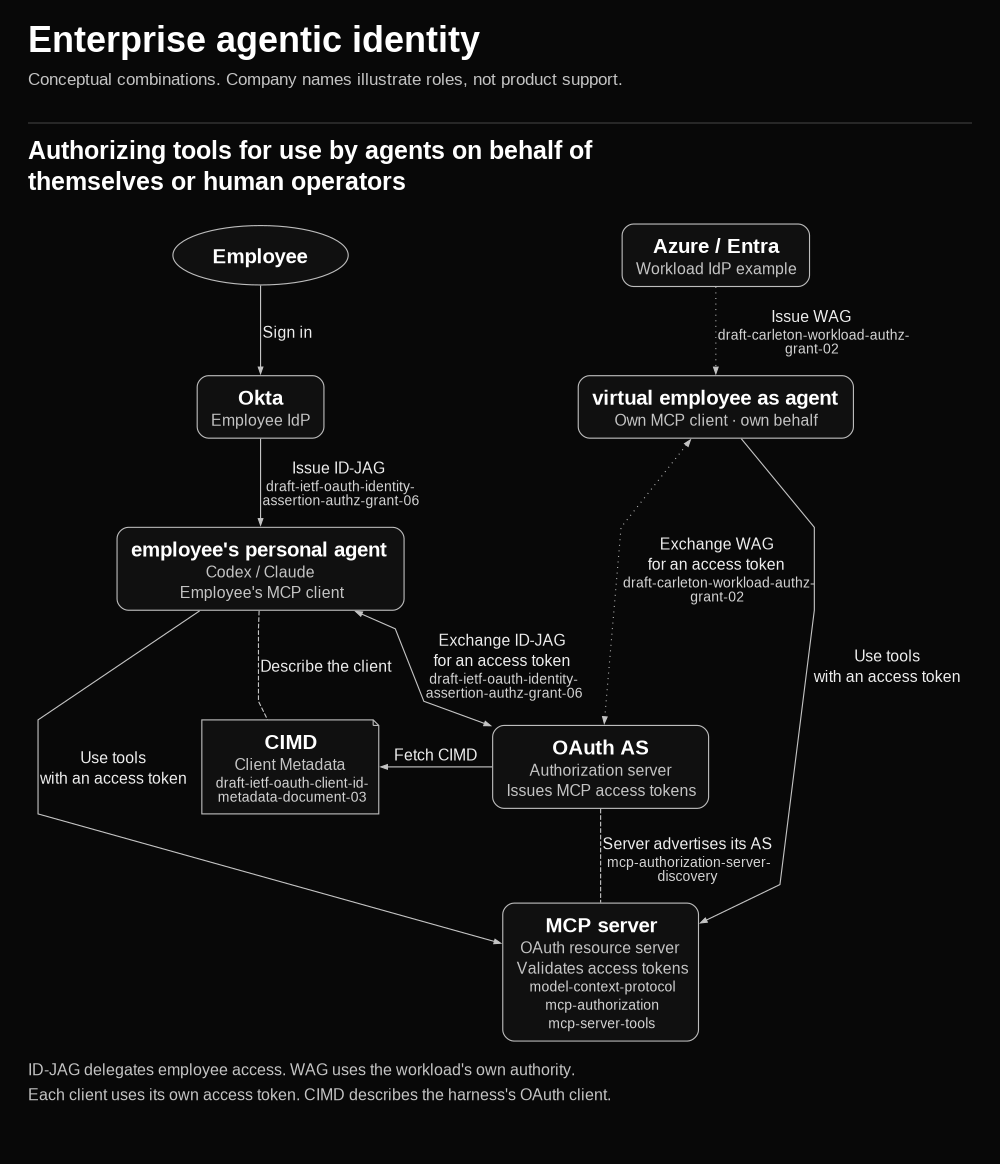
ID-JAG addresses access on a user’s behalf; WAG addresses a workload acting on its own behalf. That distinction matters as tasks cross organizational boundaries. CIMD describes another identity: the harness’s OAuth client, which can outlive any particular agent instance.
Jon Peterson’s STIR agentic draft explores agent disclosure and intent in voice calls. Voice and SMS also raise a broader question: what connects the identity authorized to use an MCP tool with the identity a recipient sees? The call proposal is one piece of that discussion; carrying delegation and intent across these boundaries remains open.
Experimentation
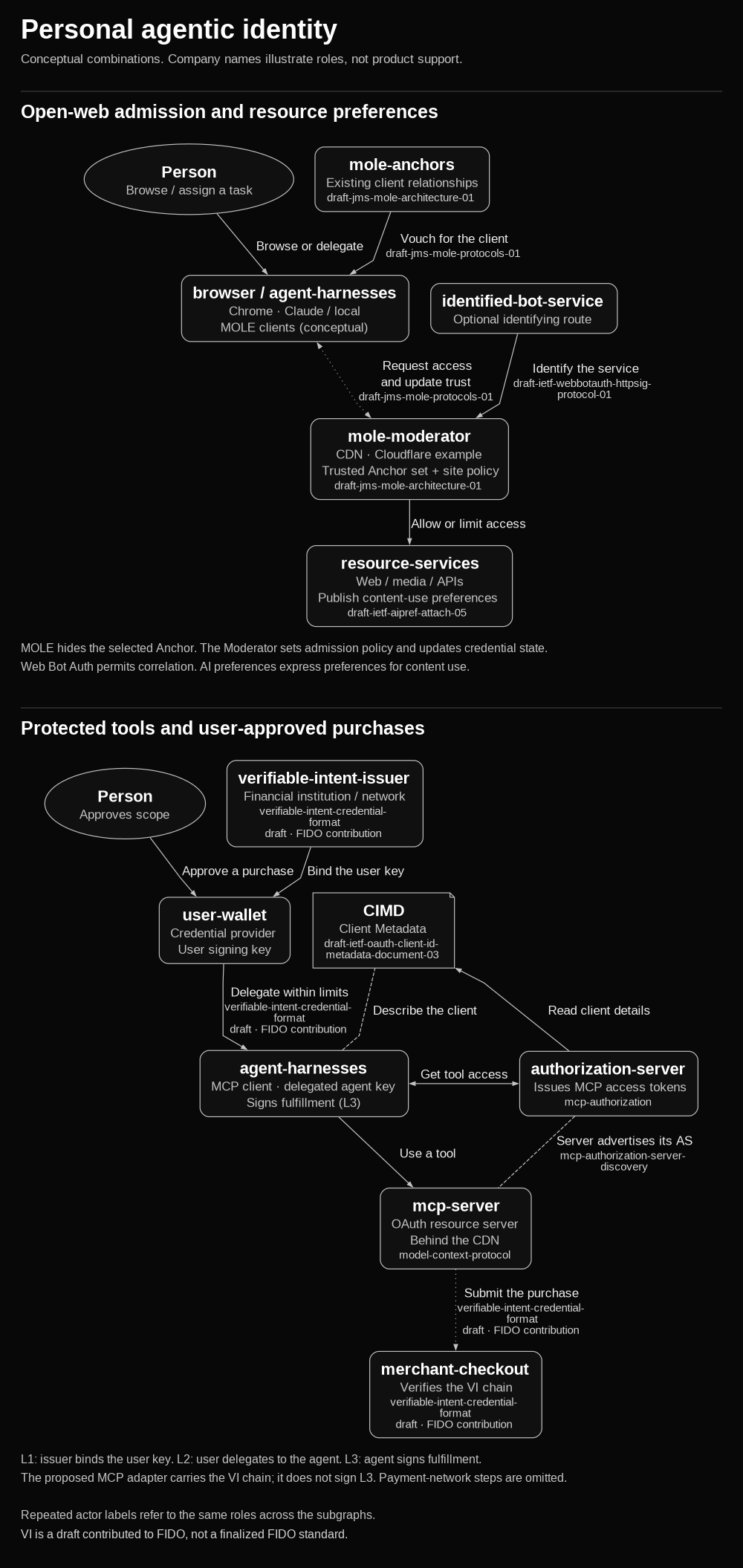
These diagrams sketch ideas to explore, not an integrated deployment. The enterprise example places employee delegation through Okta and ID-JAG beside Azure / Entra workload identity and a possible WAG exchange. The personal example follows Chrome and agent harnesses through a CDN, illustrated by Cloudflare, to public resources and protected services. The companies illustrate roles, not support for every proposed combination.
The MCP client sits inside the harness. A protected remote MCP server is an OAuth resource server: it advertises its authorization servers and accepts tokens intended for itself. The authorization server fetches CIMD from the harness’s client_id URL. Access to another API requires authorization appropriate to that API.
MOLE could govern admission and rate limits, while AI preferences express the resource operator’s content-use preferences. Mastercard’s Verifiable Intent draft, co-developed with Google and contributed to FIDO, adds purchase authorization: issuer, user, and agent keys form a signing chain. How to carry that evidence through an MCP purchase tool is an experiment. Payment checks and dispute resolution remain separate concerns.
Combining these mechanisms could make useful automation easier to accommodate. It could also concentrate access in large platforms or commercial relationships. Experiments should examine what gets correlated, how independent agents participate, and how a person can challenge an exclusion or an agent’s mistake.
Key Transparency and MOLE
The experimental MOLE and Key Transparency implementations provide a starting point, informed by the KEYTRANS discussion. Two ideas are worth testing: use MOLE to limit oblivious reads of a KT log, and use KT to expose the history of MOLE issuing keys.
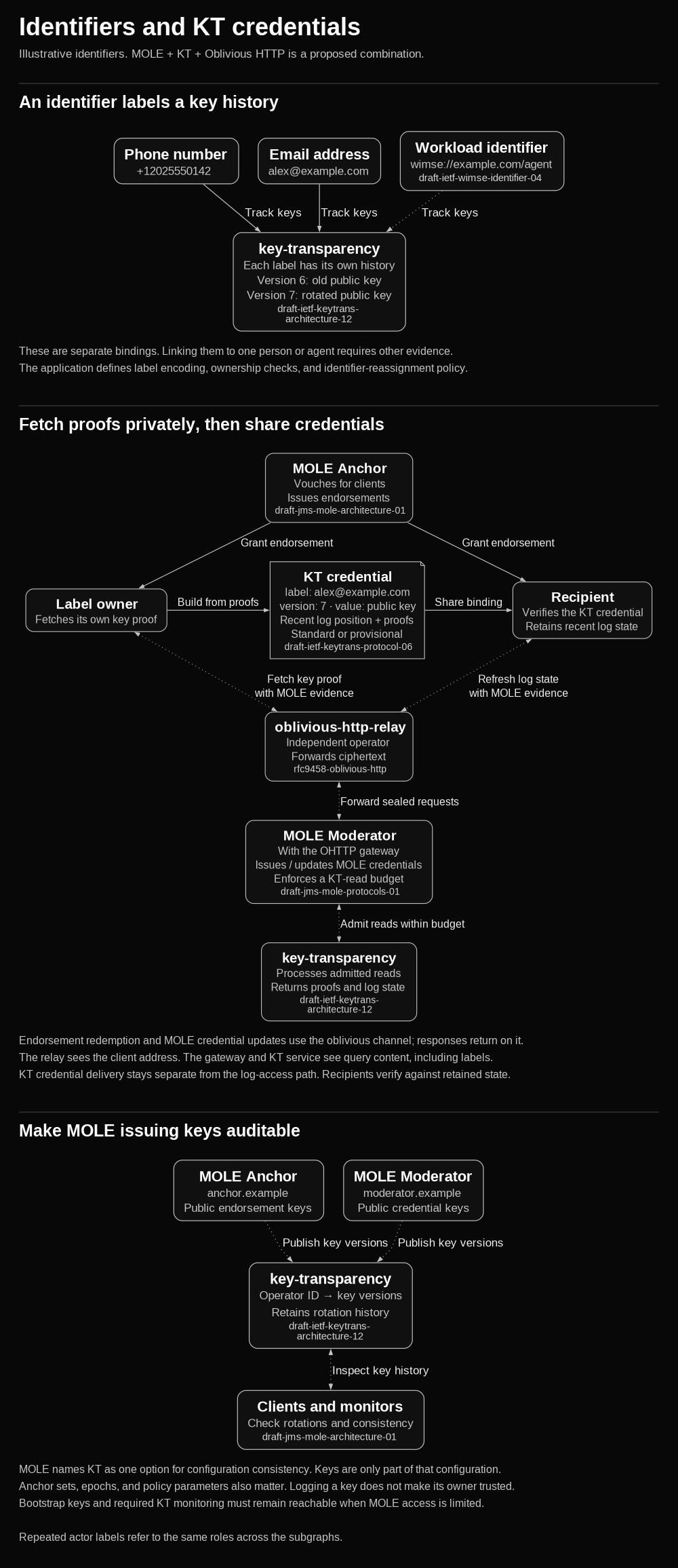
The unit to record is an identifier-to-key binding: a phone number, email address, or WIMSE workload URI such as wimse://example.com/agent. Applications still need rules for encoding identifiers, verifying control, and handling reassignment. Separate bindings do not establish that several identifiers belong to the same person or agent.
A KT credential carries a label, version, value, recent log position, and proofs from a latest-version search. A recipient checks it against retained log state instead of looking up the sender. Standard credentials anchor to an established distinguished log entry; provisional credentials need later confirmation. The architecture sets out freshness and monitoring requirements. Applications still check possession of the private key and authority to act.
A WIMSE workload credential already binds an identifier to a key; KT could add verifiable history. Persistent and ephemeral agents suggest different choices: monitor a durable principal’s binding, or record every task-scoped key? A short-lived agent might instead rely on delegation from that principal. MCP and OAuth can remain separate systems in this experiment.
For private log reads, Oblivious HTTP could carry encrypted requests through an independent relay to a gateway where a MOLE Moderator checks credentials and limits access. A label owner could fetch proofs, then send a KT credential directly to a recipient. Recipients could use the same private path to refresh log state. Privacy depends on the relay and gateway not combining their observations; the gateway and KT service still see queried labels.
In the other direction, KT could record Anchor endorsement keys and Moderator credential keys. The MOLE architecture already names KT as an option for configuration consistency. Monitored histories could expose unexpected rotations and inconsistent bindings. Consistent Anchor sets, epochs, and other configuration also matter; logging keys does not decide which issuers deserve trust.
Bootstrap and monitoring access need explicit rules. Clients require trusted log configuration and MOLE keys to begin. Rate limits must preserve the KT checks needed to detect stale or inconsistent state, including after ordinary query access is restricted.
Sources and materials
- draft-jms-mole-architecture-01
Defines MOLE Anchors, Moderators, and privacy-preserving access control. Section 11.2 names KT as one way to make configurations consistent across clients and resist split views.
- My experimental MOLE implementation
Experimental Rust implementation of MOLE’s wire format, transport, and protocol behavior.
- My Key Transparency implementation
Rust implementation of Key Transparency with interoperability work against Go implementations.
- draft-ietf-webbotauth-httpsig-protocol-01
Authenticates automated HTTP clients through signed requests and discoverable verification keys.
- draft-rescorla-anonymous-webbotauth-01
Individual proposal for anonymous endorsements and rate limiting of automated web traffic.
- draft-ietf-oauth-identity-assertion-authz-grant-06
Supports cross-domain API access on a user’s behalf through a trusted identity provider.
- draft-carleton-workload-authz-grant-02
Individual proposal for workload access across trust boundaries without provisioning each workload separately.
- draft-peterson-stir-agentic-00
Proposes identifying agents that place or answer voice calls and conveying the principal's intent to the other party.
- draft-ietf-keytrans-protocol-06
Defines key-history operations and, in section 14, the KT Credential structure: label, version, value, log position, and standard or provisional proofs. Specifies freshness checks and subsequent confirmation for provisional credentials.
- Cloudflare: Web Bot Auth
Documents Cloudflare’s verification of automated requests using HTTP message signatures.
- Okta: Cross App Access
Describes an ID-JAG implementation connecting identity providers and resource authorization servers.
- draft-ietf-oauth-client-id-metadata-document-03
Lets an OAuth client, such as an agent harness, publish metadata at its client identifier URL for authorization servers to retrieve. The client identifier does not identify every agent instance.
- draft-ietf-keytrans-architecture-12
Explains KT credentials, monitoring, and recent log state. Section 3 permits access controls while preserving required verification operations; section 5 discusses anonymizing proxies such as Oblivious HTTP.
- KEYTRANS IETF 127 minutes, revision 00
Records discussion of credential maturity and rapid key rotation, including Orie’s interest in transparency and credentials for MOLE.
- draft-ietf-aipref-vocab-08
Defines a vocabulary for expressing preferences about automated uses of digital content, including AI training and inference.
- draft-ietf-aipref-attach-05
Attaches AI usage preferences to HTTP content through Content-Usage headers and robots.txt directives. These signals are separate from access credentials.
- Microsoft Entra: workload identities
Describes identities for applications, services, and other workloads, including Azure managed identities. The diagram’s WAG connection is exploratory, not a claim of product support.
- draft-jms-mole-protocols-01
Defines endorsement proofs and Moderator credential issuance, presentation, and state updates that instantiate the MOLE architecture.
- Verifiable Intent specification, draft v0.1
Mastercard’s draft commerce authorization model: issuer, user, and agent signatures bind constrained purchase mandates. This pinned snapshot distinguishes merchant checkout checks from payment-network verification.
- Verifiable Intent credential format, draft v0.1
Defines the layered SD-JWT claims, key bindings, selective disclosures, and checkout/payment integrity links used by VI.
- Verifiable Intent security model, draft v0.1
Describes the issuer, user-key, and agent-key trust boundaries. VI provides authorization evidence; user authentication, behavioral attestation, and dispute resolution are separate concerns.
- FIDO Alliance: AP2 and Verifiable Intent
Explains the contribution of Mastercard’s VI, co-developed with Google, to FIDO’s agentic commerce work. Contribution and ongoing standardization do not make draft v0.1 a finalized FIDO standard.
- MCP authorization security considerations, July 2026
Requires tokens intended for the receiving MCP server and forbids token passthrough. A tool calling a downstream API needs authorization appropriate to that API.
- MCP authorization server discovery, July 2026
Requires MCP protected-resource metadata to list associated authorization servers. Clients discover their endpoints and keep credentials and tokens scoped to each server.
- Model Context Protocol specification, 2026-07-28
Defines MCP hosts, clients, servers, protocol messages, tools, resources, and related capabilities. The diagrams link to this version and its authorization sections.
- MCP server tools specification, 2026-07-28
Defines how MCP servers describe, list, and execute tools, including input schemas, results, and tool errors. The enterprise diagram links the MCP server to this tool interface alongside its authorization requirements.
- draft-ietf-wimse-identifier-04
Defines workload URIs, trust domains, normalization, and identifier stability. An identifier may name a logical workload shared by several instances; using it as a KT label is an experiment here.
- draft-ietf-wimse-workload-creds-03
Defines workload identity tokens and certificates that bind a workload identifier to public-key material. Presenting workloads must prove possession of the associated private key; a KT credential would provide separate evidence about the binding history.
- RFC 9458: Oblivious HTTP
Separates client network identity from plaintext HTTP requests using a relay and gateway. The relay must protect client information from the gateway; request content remains visible at the gateway and target. Used here as a possible transport for MOLE-protected KT reads.